
Every brand owner starts with the same question: what actually happens after I send my idea to a factory? The cosmetic OEM process is not one long task—it is a sequence of decisions, each with its own documents and its own deadline. Understanding the sequence is what separates a launch that moves from a launch that keeps restarting.
Below is the process as we run it at Kangbai Nian, from the first brief to the day your goods ship: what we need from you, what you receive back, and where the timeline is won or lost.
Before the Factory: The Brief That Decides Everything
A brief is not a price request. It is the document that lets a factory decide what is realistic. When it is vague, every later stage becomes a negotiation; when it is specific, sampling and pricing move quickly.
What to include in your brief
What the Brief Must Cover
- Product type and category — feminine wash, intimate gel, care oil, cream, serum, spray; and whether you bring a formula (OEM) or want us to develop one (ODM).
- Target market — Malaysia, Indonesia, Vietnam, Thailand, the Philippines or other export markets; this decides which compliance documents you will need.
- Packaging and format — product form (gel, lotion, foam, spray, oil, powder), container (bottle, tube, airless pump, jar, sachet), fill size (for example 50 ml, 100 ml, 200 ml), and whether you have artwork or need our standard options.
- Sensory targets — texture, absorption, fragrance preference, colour; plus a reference sample if you have one.
- Claims you want to make — what you hope to print on the label; we will tell you which claims are allowed in your market before you commit.
- Quantity and timing — expected first order, acceptable MOQ, and target launch date.
Terms you will hear along the way: OEM means we manufacture to your formula or a chosen base; ODM means we also develop the product; MOQ is the minimum order quantity; CoA is the certificate of analysis for each batch.
Step 1 — Formula Matching or Development
With the brief in hand, the development team either matches your requirements against our library of 3,000+ proven formulas or develops a new formula from a tested base. The output of this stage is not a promise—it is a formula direction with a known starting point, so the risk is limited to the variables you changed.
Step 2 — Sampling: What You Receive and How to Judge It
What a documented sample pack contains
A sample without documentation is just a bottle. A proper sample pack contains the sample itself, its key characteristics (texture, fragrance, pH or other relevant parameters), and notes on what can still be adjusted. Standard-formula samples typically prepare in 7–15 working days; custom samples depend on the testing your changes require, and we confirm the timeline before starting.
Test the sample the way your customer will: apply it, live with it for a few days, and check whether it matches the market you are entering—not just whether it smells pleasant in the meeting room.
Step 3 — Approval: The Point Where the Timeline Locks
Approval is not a formality. Once you approve the sample, three things are locked: the formula, the packaging specification and the label claims. Any change after this point can restart part of the stability and safety testing, which is why we confirm the approved version in writing before moving on.
Why changes after approval cost weeks
A fragrance swap or a changed claim looks small on paper, but it can restart stability testing or invalidate part of the batch documentation. Keeping the approved version fixed protects your launch date more than any promise of speed.
Approval is also where the commercial terms are confirmed. Our standard terms are a 50% deposit before production and the balance paid before shipment; the currency and payment method are agreed in the contract. We confirm these in writing together with the approved formula and packaging, so there is no ambiguity later.
Step 4 — Production: What Happens in the Factory
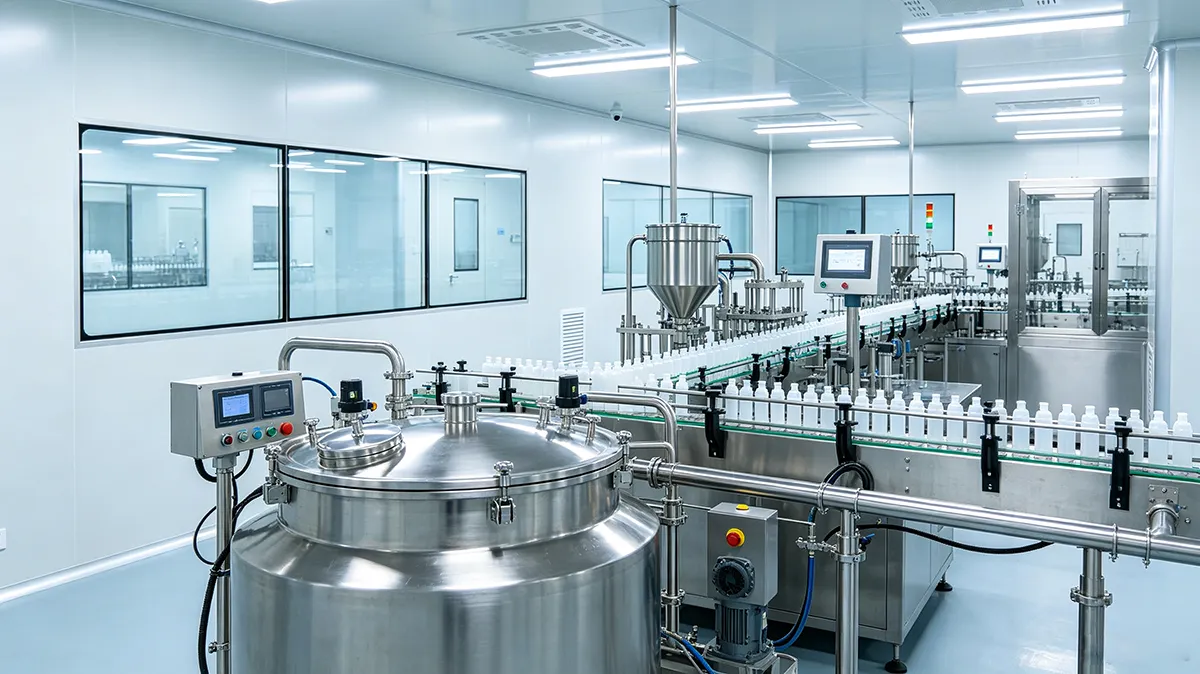
Production runs in our ISO 22716 certified, Class 100,000 clean workshop, with in-process quality control at each stage—incoming materials, filling and finished goods. Typical bulk lead times are 30–45 working days for standard formulas and 45–60 working days for custom formulas from approval. Packaging is often the longest single item: custom-printed bottles and cartons need their own production window, so they are ordered as early as possible.
Step 5 — Testing, Documents and Market Compliance
Batch testing and documentation are prepared alongside production, not after it. Depending on your market, this can include certificates of analysis, ingredient declarations, stability and safety data, and the documents your local notifier needs for registration. For Indonesia, that means BPOM notification and BPJPH halal certification; for Malaysia, NPRA notification and halal. Our manufacturing entity holds ISO 22716 and US FDA CFSAN Cosmetic GMP certificates—you can verify them here—and our Halal OEM program prepares the halal documentation while certification is in progress.
You do not have to take our word for how the factory runs. We welcome audits—on-site or by live video—and we prepare the documents in advance: certificates, production licences, QC flow, batch records and the sample-retention policy. If your compliance team has a specific checklist, send it before the visit and we will work through it with you.
One point that surprises many first-time importers: the company that files the product registration is normally the local responsible company—your importer, distributor or appointed notifier. The factory provides the manufacturing documents behind that filing: GMP/ISO certificates, formula and ingredient documentation, specifications, stability and safety data, certificates of analysis, and halal documents where applicable. We will tell you clearly which documents we provide and which ones your local team must hold, so nothing is assumed.
Step 6 — Shipping, After-Sales and Your Next Step
Finished goods ship with the commercial and compliance documents your importer or distributor needs. After delivery, the relationship does not end: batch records remain available, and future orders reuse the same approved file, which makes reordering significantly faster than a first order.
If you want the commercial picture—what we make, the MOQ by format and how we structure a project—see our OEM & ODM services page. If you are launching a feminine care line, the private label feminine care page covers washes, gels, care oil and pellets; for skincare, see the skincare line page.
Some companies choose a category because it is growing. We work in women’s intimate care because of a mission that was set before the brand name existed: 慈悲天下,关爱女性 — compassion for all, care for women. In our own words, a healthy woman makes a happier family, and that belief is why our values begin with 正心正念正行出正品,有爱有情有德有家业 — a right heart, right thought and right action produce a right product, carried out with love, feeling, virtue and family in mind.
That mission shows up in this process in very concrete ways: we do not promise a launch date the testing cannot support, we do not print a claim the formula cannot carry, and we treat every formula as if our own name were going on the label — 正心正念出正品,视产品如人品, “a right heart makes a right product; treat the product as your own character.” For a brand owner, that is not a slogan to admire. It is the standard you should hold your factory to, order after order.
Send us your brief—product type, target market, packaging idea and timing—and we will reply with the formula direction, MOQ, sample timing and the document checklist for your market. WhatsApp +86 17268316866 or zkbn_oem@outlook.com, or use the contact page.
*Lead times, testing periods and regulatory requirements vary by product and market. Confirm current figures with your factory and local advisors before committing.*