
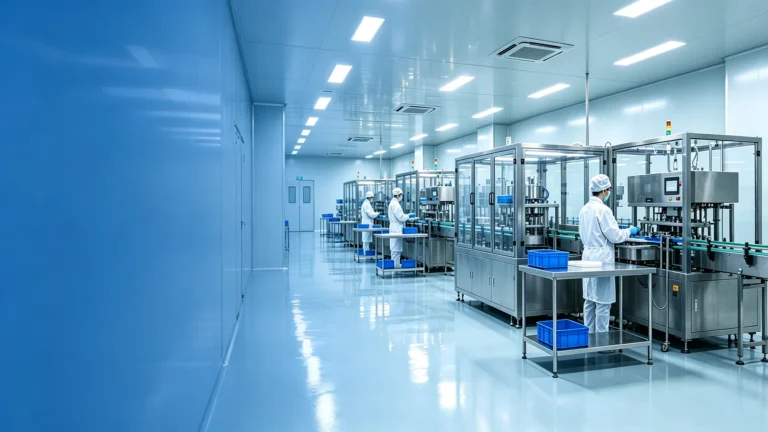
What “Class 100,000” Actually Means
The term comes from the old US Federal Standard 209E, and it is still how factories across Asia describe their workshops. A Class 100,000 room allows no more than 100,000 particles of 0.5 micron or larger per cubic foot of air. Under the international ISO system, that same room is called ISO Class 8 — roughly 3.5 million particles per cubic metre.Reaching that number takes more than a sign on the wall. The workshop pushes air through HEPA filters, keeps the room under positive pressure so unfiltered air cannot leak in, and controls who enters, what they wear, and how materials move through the room. It is not a sterile laboratory. It is a controlled, clean production environment — and for cosmetics and intimate care, it has become the industry baseline rather than a premium extra.I have walked production floors that print “Class 100,000” on a sign and floors that actually run it. The difference shows up in the details: filter maintenance records, particle count reports, gowning discipline, and whether the number still holds when someone checks. The sign is cheap. The system behind it is not.Why Purification Matters More for Feminine Care Than You Might Think
Your customers will never see the workshop, so it is fair to ask why it should matter to you. The answer is that the environment decides what happens to your batch between formulation and filling.Feminine care and sensitive-skin products spend months — sometimes years — moving through stability tests, regulatory review, and customs checks before they reach a shelf. A batch that picks up contamination during production does not always fail immediately. It can fail late, at the worst possible moment: a compliance rejection, a stability deviation, a customs hold. By then the formula on paper looks fine, but the product in the box tells a different story. This is exactly how contamination failures tend to surface: a first sample batch passes stability testing cleanly, then a production batch that sits longer than planned in a staging area comes back with microbial counts out of spec and gets held at customs. The formula did not change. The environment did.The job of a Class 100,000 workshop is to take the environment off the list of things that can go wrong. It does not make a good formula great. It protects a good formula from the factory around it.What a Class 100,000 Workshop Does for Your Product
Purification is the layer you specify last and notice only when it is missing — the foundation underneath your formula, packaging, and testing. Walk through what it actually changes for you, in the order you will feel it.Cleaner Air Where Your Product Is Filled
The highest-risk moments in a cosmetic batch are the ones where the product is most exposed: filling, sealing, and packing. A Class 100,000 workshop controls airborne particles and the people moving through those zones, so less dust and fewer microbes land on surfaces and closures. This matters most for water-based products and for intimate care formats, where the preservative system has to do its job without extra help from the room.Fewer Surprises in Stability Testing
Stability tests exist to catch problems early. Contamination introduced during production shows up in those tests as out-of-spec results — changes in appearance, odour, pH, or microbial counts. When production runs in a clean, controlled room, the batch you send to testing is the batch you designed, not the batch plus whatever the factory added. The result is fewer deviations to explain and a faster sign-off for your launch timeline.More Consistent Batches, Less Rework
Clean, controlled conditions also shrink the gap between batches. Hold the environment steady and the process follows — the finished product looks, smells, and performs the same from the first batch to the ten-thousandth. For a brand, that consistency protects repeat purchases. It also keeps your MOQ and lead-time promises realistic, because rework and re-runs shrink.How to Verify an OEM’s “Class 100,000” Claim
A line on a website is not verification. When a supplier tells you they run a Class 100,000 purification cosmetic workshop, ask for evidence you can actually read:- Recent air particle count reports for the room your product will be made in — not one certificate from years ago.
- Which standard the monitoring follows (ISO 14644-1 or the Chinese GB 50457), and how often counts are taken.
- The HEPA filter testing and replacement records.
- A live video walkthrough: gowning area, airlock, production floor, and filling line.
- How materials and people move through the room — a clean room is only as good as its discipline.
What Class 100,000 Does Not Do
Being honest about the limits is what makes a supplier credible. A Class 100,000 workshop is not a guarantee of product quality on its own. It does not fix a weak formula, replace raw material control, substitute for finished-product microbial testing, or make a product sterile. It is one layer in a system that also needs a functioning QC laboratory, documented processes, and competent people.Treat the grade as a necessary condition — the floor a serious manufacturer should stand on — not as a magic badge. The right question is not only “do you have Class 100,000?” but “what else do you run alongside it?”Inside Kangbai Nian’s Purification Workshops
To make this concrete, here is what our own setup looks like. Kangbai Nian has operated for 21+ years across six large-scale production facilities covering more than 20,000 square metres, including Class 100,000 purification workshops and GMP-compliant production lines. Our in-house R&D team and internal laboratory support custom formulas from a library of 3,000+ proven formulations, and our own plantation base gives raw material traceability from source to finished goods. More than 1,000 brands worldwide have run private-label programs with us.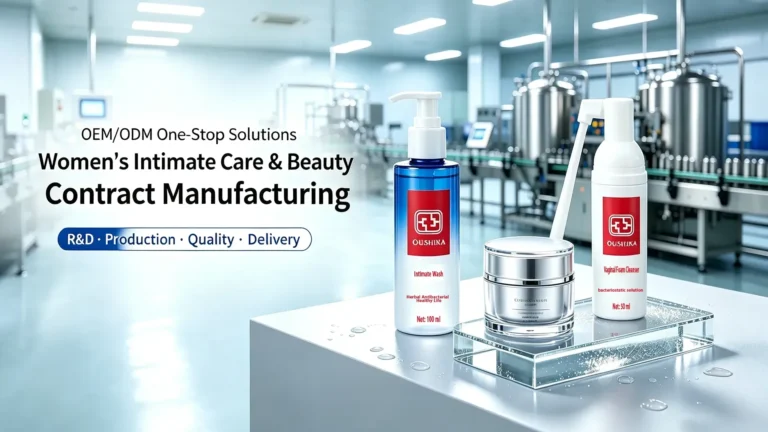
FAQ — Class 100,000 Purification Workshops
Is Class 100,000 the same as ISO 8? Yes. Class 100,000 (US Federal Standard 209E) corresponds to ISO Class 8 under ISO 14644-1. Factories in Asia often still use the older “Class 100,000” wording.Does a Class 100,000 workshop make products sterile? No. It controls airborne particles and contamination risk, but it is not a sterile environment. Finished-product microbial testing is still required.How do I check whether an OEM really runs Class 100,000? Ask for recent air particle count reports, the monitoring standard, HEPA filter records, and a live video walkthrough of the workshop. Treat certificates as a starting point, not proof.Is Class 100,000 the highest cleanroom grade? No. Grades go tighter — Class 10,000 (ISO 7), Class 1,000 (ISO 6), and beyond. For cosmetics and intimate care manufacturing, Class 100,000 / ISO 8 is the standard baseline.Does a higher cleanroom grade mean a better product? Not automatically. Grade is one layer; formula, raw material control, QC, and people matter as much or more. Verify the whole system, not a single number.Start with a Factory You Can VerifyThe cheapest time to learn about a supplier’s cleanroom is before you sign, not after a customs hold. Ask for the particle count reports, take the video tour, and judge the workshop by what you can verify — then let a pilot batch confirm the rest.Talk to the Kangbai Nian team: WhatsApp +86 17268316866 or zkbn_oem@outlook.com, or use the contact page to request particle count reports and a video factory tour.Next step: certifications & quality.
Related next steps: Review private label feminine care manufacturing, OEM/ODM services.