
Last autumn, a brand owner from Kuala Lumpur reached out to me on WhatsApp.
She had sourced from a manufacturer in Guangzhou. The samples looked great, and the price was competitive. When her first shipment of 5,000 units arrived at Port Klang, she opened the cartons and found sediment at the bottom of every bottle. She sent photos to the factory, and they told her “it’s normal, just give them a shake.”
She consulted three independent labs. All confirmed the preservative system was unstable and wouldn’t hold up for 12 months. In total, the incident cost her nearly 20,000 MYR in wasted stock, port detention fees, and repackaging costs.
She asked me: “You work in manufacturing. Can you tell me how to actually choose a reliable factory?”
I get asked this question a lot — from brand owners in Indonesia, the Philippines, Dubai, Poland, and Australia. After 21+ years in intimate care OEM manufacturing, my biggest takeaway is this: every market has its own regulatory, climate, and distribution pitfalls, but the core principles for choosing a factory are universal.
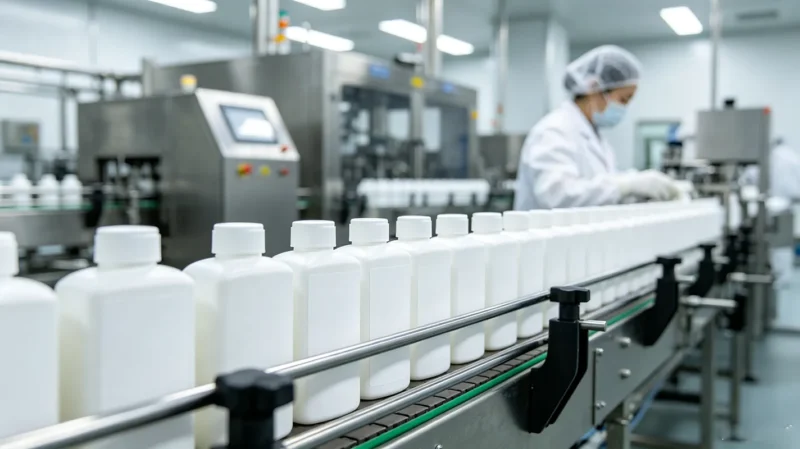
Most people look at all the wrong things when they evaluate a manufacturer.
Below are the 7 criteria I believe matter most. Not factory size, not the number of certificates, not the lowest quote — the things that actually determine whether your product will sell smoothly.
1. The Minimum Batch Volume Trap: Why MOQ Is Not the Whole Story
When brand owners tour a factory, they usually start by checking how big the facility is and how much equipment it has. That’s not wrong, but it misses the point.
The biggest driver of consistent quality for liquid products like intimate washes is minimum production batch volume — the minimum volume of raw material a production line must run to ensure proper mixing, homogenization, and temperature control. That number directly determines whether your small test order will actually be stable.
For our full production lines, the standard minimum batch is 2 metric tons. For a 150ml bottle, that is roughly 13,000 units. A lower 500kg MOQ is supported on validated smaller reaction vessels. If batch scheduling is used, it is limited to the same client and approved formula, or to a manufacturer-owned base formula with written approval. Different brand formulas are never combined. This allows smaller market-testing orders without compromising traceability or batch consistency.
We would rather tell a client upfront that 2 tons is the minimum for consistent quality, than accept a small order and deliver something unstable. This is exactly why some factories quote a “500kg MOQ” but deliver unstable product. They’re mixing up quoted MOQ with minimum production volume. The first is the smallest order they will accept; the second is the smallest volume they can reliably produce. You need to ask about the second one.
Questions to Ask Before You Commit
Ask directly: “What is the minimum batch volume your production line needs to run to support consistent quality for this product?” The answer is more useful than a certificate alone.
2. Retention Samples: Your Real Quality Safety Net
Every factory will show you ISO 22716, GMP and SGS certificates. Those are real, but they only verify that the factory’s quality management system meets a standard. They do not guarantee that your specific batch will be problem-free.
What actually determines batch quality is the retention sample system.
Retention sampling means the factory sets aside several units from every production run, stores them in a temperature-controlled chamber, and inspects them on a regular schedule. If your product develops sediment, discolouration, or pH drift six months later, the factory can pull the retention samples, compare them, and identify whether it was a formula issue, raw material issue, or filling issue.
Factories without a proper retention system will just say “it was fine when it left our facility” — and there’s nothing you can do about it.
This is true for every market, tropical or temperate. For any liquid product shipped across borders, retention sampling is the most basic quality safeguard there is.
Request the retention-sample SOP: “Do you keep retention samples from every batch? How long do you keep them, and how often do you test them?” A vague answer is a warning sign.
3. Stability Testing: Why “Fine in the Lab” Fails in Port Klang
The biggest enemy of intimate care washes is not bacteria — it’s temperature fluctuation.
Most people assume stability only matters for tropical markets. That’s not true. Shipments to Southeast Asia sit on docks for a week in direct sun. Shipments to Europe cross the equator and go through massive temperature swings. Shipments to cold-climate countries sit in sub-zero warehouses for weeks in winter. Different markets demand very different stability performance.
These are the standard industry testing profiles for different destinations:
- Tropical markets (Southeast Asia, Middle East, Africa): 40°C, 75% RH, 90-day accelerated testing, simulating hot-humid storage and ocean freight conditions.
- Temperate / long-route markets (Europe, North America, Australia & New Zealand): 37°C cycling temperature + humidity simulation, 90 days, covering temperature swings during cross-equator shipping.
- Cold markets (Nordic Europe, Russia): Additional -5°C freeze-thaw cycle testing to prevent separation and solidification at low temperatures.
There’s a common misunderstanding here: this does not mean every shipment has to wait 90 days before leaving the factory. Accelerated stability testing is done during formula development, to validate shelf life ahead of production. Once a formula is validated and goes into regular production, batches are shipped normally while retention samples are monitored in parallel. It usually does not affect lead times.
I once worked with a brand owner in Manila who launched a 500-unit wash with a local factory. Three months in, customers started complaining about an odd odour. The factory blamed her storage conditions; the warehouse said it was a formula problem. Both sides pointed fingers, and she covered the loss.
When we reviewed the situation, that factory had only been making intimate care products for under a year, switched raw material suppliers frequently, had never done tropical accelerated stability testing, and had no proper retention sample system. When something went wrong, there was no way to trace why.
We helped her reformulate, adjusted the preservative system, and ran full 40°C accelerated stability testing. Her next batch shipped to Manila with zero odour complaints. Today, she sells steadily on Shopee with 80% fewer customer complaints, reordering around 2,000 units per month.
Check the stability protocol: “Have you done accelerated stability testing matched to my target market? What were the exact conditions?” If the factory cannot name the test parameters, be careful.
4. Registration Documents: Can Your Factory Actually Deliver a Clean File?
Intimate care products have different registration requirements in every country. Malaysia uses NPRA, Indonesia uses BPOM, and the Philippines uses the Philippine FDA, formerly BFAD. The EU uses CPNP notification, the UK uses SCPN, GCC markets apply GSO standards and local registration rules, and Australia uses AICIS.
A lot of factories will tell you “we export to many countries” — but if you ask them what factory documents are required for EU CPNP notification, they can’t answer.
A factory doesn’t need to handle registration for you (that must be done by a local responsible entity). But it absolutely must be able to provide the factory-side documentation required for registration: INCI formulation, COA, stability reports, microbiology reports, GMP certificates, and authorisation letters.
If a factory can’t put together a clean, complete document set, your registration will get stuck — often for 2–3 months. We had a Polish client last year who used a domestic factory, and her shipment was held at the Port of Rotterdam because the INCI information in her CPNP file was incomplete. Port detention fees alone ran into thousands of euros. We prepared a full set of EU-compliant factory documents, worked with her local responsible person for resubmission, and her second shipment cleared customs smoothly. She told me later that her previous factory couldn’t even explain basic INCI formatting properly, and she would never again go with the cheapest quote.
Documents to Request
Request the market-specific document checklist: “Can you provide the full set of factory documents required for registration in my market?” A clear list shows the factory has worked in that market before.
5. The Communication Test: Price Will Not Save a Project from a Slow Factory
This one doesn’t sound like a manufacturing criterion, but it makes the biggest difference to your experience.
How fast do they reply to your emails? When you ask a technical question, do they answer directly or talk in circles? When you request a modification, do they say “we can do that” or do they immediately say “that will cost extra because…”?
Intimate care OEM is a detail-heavy business. From formula adjustments to packaging approvals, from sampling to production, there are dozens of touchpoints. If the factory is slow, opaque, or vague in communication, your project will drag.
This is true in every market, and for every order size. Whether it’s a 500kg test order or a multi-ton repeat order, a responsive, transparent factory will save you half the hassle.
Before you place a sample order, have a few back-and-forth exchanges with the factory. Judge their response speed, technical clarity, and honesty. That tells you more than the quote sheet.
6. Category Experience: 2 Years vs. 21+ Years in Intimate Care
Many people check the founding date on the business license, but that’s not enough. You’re not looking for a company that’s existed for X years — you’re looking for a company that’s been making intimate care products for X years.
The difference between a factory with 2 years in the category and one with 21+ years is never equipment size. It’s the number of problems they’ve worked through. It’s the difference between a 3-year-old and a 20-year-old: when something goes wrong, a new factory panics, blames others, and looks things up on the fly. An experienced factory can immediately tell you where the problem is, how many ways there are to fix it, and which one costs the least.
We’ve seen too many new factories with brand-new equipment and full sets of certificates, but when a shipment has issues at port or products go bad on the shelf, they have no real troubleshooting experience and just pass the buck. A factory that’s been doing this for many years has seen the same problem dozens of times. They can tell at a glance whether it’s formula, shipping, or storage — and they can often warn you ahead of time where a given market tends to trip people up.
At Kangbai Nian, we have been focused exclusively on intimate care OEM manufacturing for over 21 years. We’ve worked through high-temperature product failures in Southeast Asia, regulatory documentation gaps in the EU, and Halal certification requirements in the Middle East. The more pitfalls you’ve worked through, the clearer the solutions are.
One hidden pitfall to watch for: don’t just look at company age — look at how long they’ve specifically been making intimate care products. A lot of factories have existed for 10+ years making general household chemicals, and only switched to intimate care last year. They look experienced on paper, but they’re still new to the category and will hit every pitfall there is.
Bring the specifics to the table: “How many years have you been manufacturing intimate care products specifically? When was your first order for my target market?” Category experience matters more than a wall of certificates.
7. Raw Material Supply Chain: Why the Same Formula Costs Differ
There’s a saying in our industry: formula sets the ceiling, raw materials set the floor. The same formula can perform completely differently depending on the grade of raw materials used.
It’s a lot like traditional Chinese medicine: the same prescription works very differently with genuine, region-sourced herbs versus mass-grown greenhouse herbs. It’s the same with botanical extracts in intimate care products. Naturally grown ingredients and mass-produced greenhouse ingredients differ enormously in gentleness, scent profile, and active performance. Even preservative systems: food-grade raw materials vs industrial-grade raw materials can differ by a factor of two in effective shelf life.
A lot of clients compare factories on price and wonder why the same formula costs so much more from one supplier to another. This is why. A common tactic from low-price factories is to use high-grade raw materials for samples, then quietly switch to lower-grade materials for bulk production. The product looks and smells similar at first, but after 3–5 months it starts to discolour, develop off-odours, or even cause irritation — and the brand owner takes the loss.
A reliable factory has a stable, fixed supply chain. For core botanical ingredients, they will even have long-term partnership plantations. Every batch of raw material comes with its own test report, and quality is locked in from the source. They don’t cut raw material grades to win orders, and they don’t switch suppliers every few months, which causes batch-to-batch inconsistency.
We own a 5,400-mu (approximately 360-hectare) herbal plantation base in Meishan, Nan’an, Quanzhou, Fujian — the Huangqijian Ecological Plantation Base. Our core botanical extracts are grown on contract and harvested on schedule, with every batch accompanied by active ingredient testing and pesticide residue reports. Quality is locked in from the source. One of the core reasons our bulk production has stayed consistent for so many years is that we never downgrade raw material specifications.

Warning Signs in the Supply Chain
Review the raw-material traceability file: “Are your core raw material suppliers fixed? Does every batch come with test reports? Do you have partnered plantations for botanical ingredients?” Traceable materials support a traceable product.
The one thing that matters most
Both the Kuala Lumpur brand owner and the Polish client said roughly the same thing at the end of their projects: “When you choose a factory, you don’t choose the cheapest one. You choose the one you can actually reach when something goes wrong.”
If a factory tells you to “shake it” when sediment appears, they’re not fixing the problem. They’re shaking off the responsibility.
That, really, is the whole point of this article.
Note for brands: Regulatory requirements vary by market. Final claims must match the finished formula and local regulations. Brands should confirm all registration and testing requirements with local authorities before launch.
If you’re evaluating private label intimate care OEM manufacturers — whether for Southeast Asia, the Middle East, Europe or Australia — feel free to send us your questions. We won’t necessarily take on your project, but we can tell you which pitfalls you can avoid.
WhatsApp: +86 172 6831 6866
Email: zkbn_oem@outlook.com
FAQ
How do I verify a private label intimate care OEM manufacturer?
Check the legal manufacturing entity, product-category licence, certificate scope, retention-sample process, stability protocol, batch records, and communication history. Certificates alone are not enough.
What documents should the factory provide?
Request the INCI formulation, finished-product specification, COA, stability report, microbiological report, GMP and ISO documentation, label-review support, and batch records. The local responsible entity still handles market registration.
Are samples chargeable?
Yes. Samples are chargeable. The sample fee and shipping are quoted separately, shipping is paid by the buyer, and any credit against the first bulk order must be agreed in writing before dispatch.
Does MOQ equal minimum batch volume?
No. MOQ is the smallest order a factory accepts. Minimum batch volume is the smallest volume its production line can run consistently. Ask about both, and confirm which vessel or scheduling method will be used.
How long should stability testing take?
Accelerated stability testing is normally completed during formula development. Once the formula is validated, production can continue while retention samples are monitored in parallel. The exact protocol depends on the target market and packaging.
Final Checklist Before You Place a Sample Order
Before paying a sample fee, confirm the legal manufacturer, certificate holder, minimum batch volume, retention-sample SOP, stability protocol, registration-document checklist, packaging responsibility, and written commercial terms.
Next Step
If you are comparing private label intimate care OEM manufacturers, send your product format, target market, packaging direction, and expected first order volume. We will tell you which parts are already covered by our standard formula programme and which parts need development.
Request a Quote · Book a Factory Tour · WhatsApp: +86 172 6831 6866