
There are two versions of custom formulation. One sounds attractive and costs months: start from a blank page, invent a formula, and hope it survives stability. The other is the version that actually launches—where the starting point is a formula library that has already been tested, and “custom” means the part your customers will feel: texture, fragrance, actives, packaging, and the story on the label. A custom formulation intimate care OEM launch depends less on how custom it is than on how much of the work was already done before you arrived. This guide explains how a 3,000+ formula library turns custom formulation from a long project into a controlled one.
Why Custom Formulation Feels Slower Than It Needs To
Most delays in custom projects do not come from the formulation work itself. They come from the number of open questions at the start. If the formula, the base, the preservative system, the fragrance, and the stability profile all have to be invented together, every change ripples through everything else. One revision in a claim can force a re-test. One late ingredient decision can restart a stability window.
Treat every part of the formula as equally new, and you have built the delays into your own timeline. Experienced OEM teams do the opposite: they fix the parts that do not need to change and concentrate the custom work where your brand actually differs from what is already on the shelf.
What a 3,000+ Formula Library Actually Buys You
What does a formula library actually do for you? Mostly it removes the “start from zero and hope” stage. That single fact changes the risk profile of your project more than any other part of the brief.
A Starting Point, Not a Template
When your brief says “clean, gentle, fast-absorbing,” a good library already contains bases that behave that way. The team starts from a base with a known sensory profile instead of inventing one. Your brand still gets its own formula—the differentiation happens in the selection of actives, the texture tuning, the fragrance, and the finished product story. The base is the head start, not the limit.
Bases That Have Already Been Through Stability
The expensive surprises in personal care are not the ingredients on paper; they are the interactions that show up weeks later—colour shifts, separation, preservative stress. A library base has already been through the testing cycle at least once, which means the unknown variables in your project shrink to the ones you actually changed. That is where the calendar time is saved.
Faster Samples Without Cutting Corners
There is a difference between rushing and starting ahead. With a library, a first sample can be built quickly because the formulation work focuses on a small set of variables. The sample is still made in a real lab, still checked, and still documented—it just does not start from zero. Shorter sample cycles are the honest result of fewer unknowns, not of skipping steps.
How a Brief Becomes a Formula
How we get from brief to sample matters more than how fast we promise to get there. A reliable route looks like this:
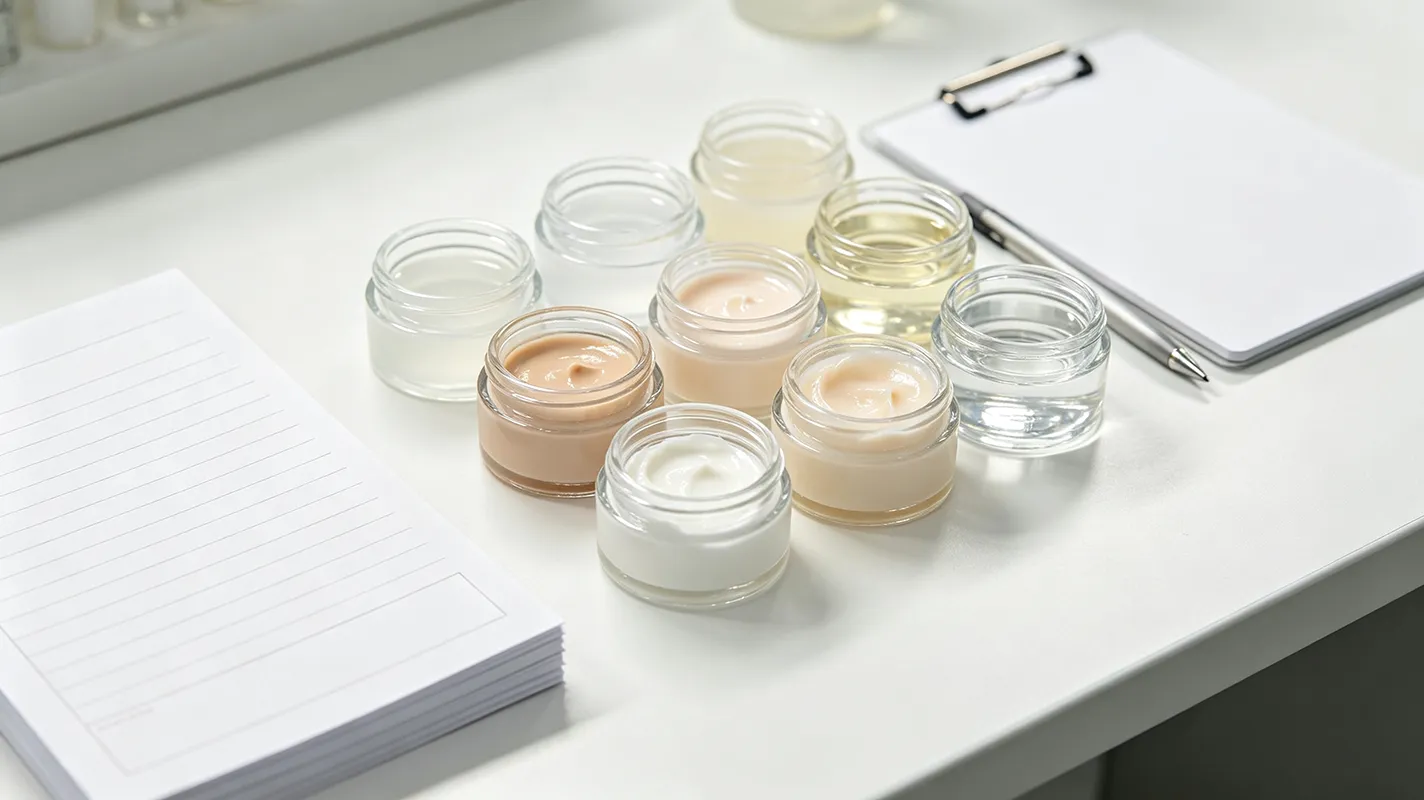
- Your brief and any reference sample set the target: feel, use, fragrance, packaging, and the claims you want to be able to make
- The development team matches the brief against the formula library and proposes one or two starting bases
- Custom elements are added—active selection, texture adjustment, fragrance, and any colour or sensory tuning
- Stability and safety checks run on the changed variables, not on a blind re-invention
- A sample is produced, documented, and sent to you with clear notes on what can still be adjusted
What happens after the sample matters as much as the formulation itself, so we walk through it separately in our private label sampling guide—the steps from approved formula to first batch.
The Difference Between a Sample and a Launch-Ready Formula
A sample that looks right is only the beginning. A launch-ready formula comes with documentation: stability data, the certificate of analysis, ingredient declarations, claim-safe wording, and—if you sell into Indonesia or Malaysia—Halal-compliant documentation from the same production line. When you choose an OEM, ask which of these documents are standard and which are extras. The ones treated as extras are usually the ones that delay your filing later.
What to Ask an OEM Before You Say “Make It Custom”
- Do you start from an existing base, or from a blank page? Ask to see the bases that match your brief
- Which of your products were built on your formula library, and which were built from scratch?
- What is included in your standard sample: stability data, CoA, ingredient declarations?
- If my claim changes after the sample, does the formula have to be re-tested from scratch?
- Do you support Halal documentation on the same line that will produce my product?
Before you ask any of this, decide which kind of project you are starting. If you have a reference sample you like, the job is matching and refining. If you are starting from a concept and a mood board, you need more guidance on what is realistic for your category. If you already need a certified or Halal-compliant product, that constraint should shape the brief from day one. The OEM you choose should adapt to your starting point, not force you into theirs.
What This Looks Like at Kangbai Nian
When a brief arrives at our development team, it is matched against a library of more than 3,000 proven formulas built over years of OEM and ODM work. The team then concentrates the custom work where the brand differs—whether that is a private label intimate care gel with a specific texture, or a feminine liquid wash with a particular sensory profile. The formula, the documentation, and the sample come from the same in-house R&D and quality systems, so what you approve in the sample is what the batch records will match in production.
How to Start Your Custom Formulation Project
Start with the information an OEM needs to judge the project honestly: your target market, your category, the feel you want, any reference sample, and your launch timing. You do not need a finished formula—that is the part we do together. Not sure which starting point fits your project? Send your brief through the contact page, or reach us on WhatsApp +86 17268316866 or zkbn_oem@outlook.com, and we will tell you which parts of your project the library already solves and which parts need real development time.
Formula claims and category rules vary by market. Treat this article as guidance, and confirm claims, testing and registration requirements with your OEM and local advisors for each target market.